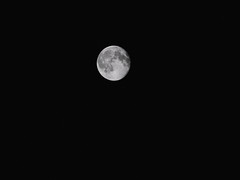
There are loads of pictures of the full moon available and with simple instructions any amateur astronomy follower can make their own but this one is particularly evocative.
Wednesday, September 8, 2010

Thursday, August 26, 2010
WISE Captures the Unicorn's Rose
A new cosmic image taken by NASA's Wide-field Infrared Explorer (WISE) shows the Rosette nebula located within the constellation Monoceros, or the Unicorn.
This flower-shaped nebula, also known by the less romantic name NGC 2237, is a huge star-forming cloud of dust and gas in our Milky Way galaxy.
We're just blogging this at astronomy for beginners because it's such a beautiful image.

This flower-shaped nebula, also known by the less romantic name NGC 2237, is a huge star-forming cloud of dust and gas in our Milky Way galaxy.
We're just blogging this at astronomy for beginners because it's such a beautiful image.
Sunday, August 22, 2010
Fireball on Jupiter
FIREBALL ON JUPITER: An amateur astronomer in Japan has video-recorded a fireball on Jupiter. This marks the third time in only 13 months that amateur astronomy buffs have detected signs of something hitting the giant planet. Will the latest impact leave behind a visible cloud of debris? . SPACE STATION and SPACE PLANE FLYBYS: This is a good week for satellite watchers in the USA and Canada. Both the International Space Station and the US Air Force X-37B space plane are making a series of favorable passes over North American towns and cities. The spacecraft are easy to find using our Simple Satellite Tracker--an app for iPhones and Android. Visit http://simpleflybys.com for downloads and more information.
Wednesday, August 11, 2010
Perseid Meteor Shower Peak August
PERSEID METEOR SHOWER
The annual Perseid meteor shower is underway. Earth is passing through a wide stream of debris from Comet Swift-Tuttle, and each time a fleck of comet dust hits Earth's atmosphere - flash! - there is a meteor. Forecasters say the shower will peak on Thursday, August 12th, and Friday, August 13th. You can see Perseids flitting across the sky at any time between about 10 pm on Thursday evening and sunrise on Friday morning. Observers who get away from city lights can expect to count dozens of meteors per hour, especially during the dark hours before dawn.
BONUS: If you go outside a little early on Thursday evening, around sunset, you'll see a beautiful gathering of planets in the sunset sky--Venus, Mars, Saturn and the crescent Moon. It's a nice way to start a meteor watch.
The annual Perseid meteor shower is underway. Earth is passing through a wide stream of debris from Comet Swift-Tuttle, and each time a fleck of comet dust hits Earth's atmosphere - flash! - there is a meteor. Forecasters say the shower will peak on Thursday, August 12th, and Friday, August 13th. You can see Perseids flitting across the sky at any time between about 10 pm on Thursday evening and sunrise on Friday morning. Observers who get away from city lights can expect to count dozens of meteors per hour, especially during the dark hours before dawn.
BONUS: If you go outside a little early on Thursday evening, around sunset, you'll see a beautiful gathering of planets in the sunset sky--Venus, Mars, Saturn and the crescent Moon. It's a nice way to start a meteor watch.
Saturday, May 8, 2010
Saturn's small moons Beyond Rings
Two of Saturn's small moons can be seen orbiting beyond the planet's thin F ring in this Cassini spacecraft image

Sunday, April 11, 2010
Prometheus Between Rings
Saturn's A ring appears bright compared to the thin F ring, which is shepherded by the moon Prometheus, in this view from the Cassini spacecraft.

Saturday, January 9, 2010
WISE 'First-Light' Image
This infrared snapshot of a region in the constellation Carina near the Milky Way was taken shortly after NASA's Wide-field Infrared Survey Explorer (WISE) ejected its cover. The "first-light" picture shows thousands of stars and covers an area three times the size of the moon. WISE will take more than a million similar pictures covering the whole sky.

Saturday, October 24, 2009
Portrait of Bright Spokes
The moons Mimas and Pandora join bright B ring spokes in this Cassini captured scene.

Saturday, September 5, 2009
First Star Trail Attempt
Here's a great demonstrationn of how beginners can take pictures of star trails with no special astronomy equipment::
Clever stuff on the astronomy for beginners group.

To achieve this photo I used the following:
My K7
No tripod (I just sat the camera on the ledge)
16 shots in raw plus one dark frame (turned off slow frame NR, then turned it back off tor the dark frame)
ISO 500
f6.3 (Pentax DA16-45)
30" Shutter
Cable Release (I found interval timer inbuilt didn't work properly for some strange reason, I think because of the buffer limits)
Photoshop CS4
Lightroom (to process the raws)
Star Trails (this app really suprised me, its amazing)
Vertus fluid mask
Believe it or not I used absolutely no noise reduction software.
Clever stuff on the astronomy for beginners group.
Wednesday, August 19, 2009
Monday, June 1, 2009
Subscribe to:
Comments (Atom)